You Can't Hit A Target You Can't See

Zig Ziglar said it best. You can't hit a target you cannot see, and you cannot see a target you do not have.
Most people nod along when they hear that line. Then they go right back to living without a target at all.
Not a business target. Not a fitness target. Not a financial target. Just a vague sense that things should be getting better, with no actual way to know if they are.
Here is the problem with vague. Vague cannot be measured, and if it cannot be measured, it cannot be improved. You can want to lose weight, want to pay off debt, want to grow your business, and still have absolutely no idea whether last month moved you closer or further away. Wanting something and tracking something are two completely different activities, and only one of them actually works.
Why Watching A Number Changes Behavior
There is a strange thing that happens the moment you start writing a number down every week instead of just thinking about it.
You start noticing patterns you would have missed. You catch yourself slipping before it becomes a real problem. You start making small corrections instead of waiting for a big wake up call.
This is not a business specific idea. It is true almost everywhere.
Someone trying to lose weight who steps on a scale every single week almost always does better than someone who avoids the scale and just hopes their clothes fit looser. Not because the scale burns calories. Because the number forces honesty. It turns a feeling into a fact.
Someone paying off debt who tracks the balance dropping every month stays motivated in a way that someone who never looks at the total simply does not. Watching the number shrink is proof the plan is working. Without that proof, it is easy to quietly give up.
Someone building a sales career who tracks calls made, meetings booked, and deals closed every week knows exactly where their pipeline is weak. Someone who does not track it just feels busy and hopes it adds up to something.
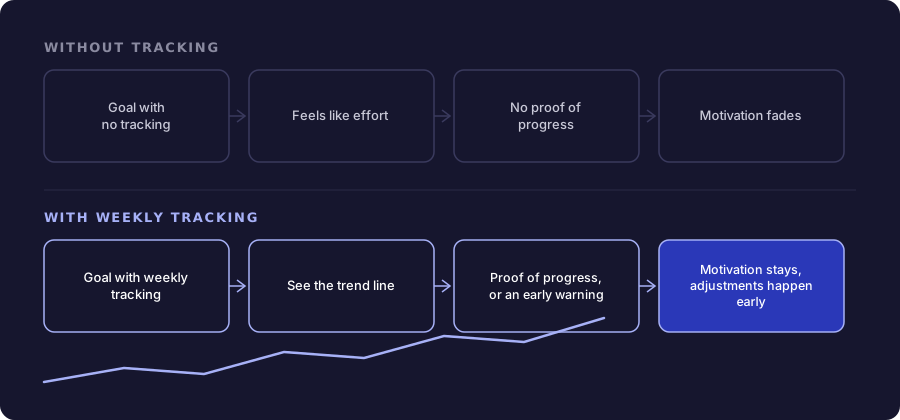
The Goals People Actually Care About Are All The Same Underneath
Here is something worth noticing. The specific goal barely matters. The mechanism behind hitting it is the same every time.
Losing weight, gaining muscle, paying off debt, growing revenue, saving money, studying more hours for an exam, practicing a sport, building a following, all of it works the exact same way. Pick the one number that best represents progress. Track it on a consistent schedule. Look at the trend, not just the single latest data point. Adjust based on what the trend tells you.
A single data point tells you almost nothing. Losing two pounds one week and gaining one pound the next week looks like failure if you only look week to week. Looking at eight weeks in a row on a line graph tells you the truth, which might be a slow and steady downward trend that is actually working exactly as it should.
This is why a line graph specifically, not just a number on a page, matters so much. A single number is a snapshot. A line graph is a story. It shows you direction, not just position.
Why This Applies Just As Much To Life As It Does To Business
People tend to separate their business goals from their personal ones, as if one deserves real tracking and the other does not.
That separation does not really hold up. A business owner who tracks revenue every week but never tracks their own hours spent working, or the debt they are personally trying to pay down, is only getting half the picture. Your business and your personal life are running at the same time, off the same energy and the same bank account. Ignoring half of your goals just because they are personal instead of professional means flying blind on things that genuinely affect your life just as much as revenue does.
The same rule applies either way. If it matters to you, it deserves a number. If it has a number, it deserves a graph.
Start With One Line
You do not need to track twenty things to get the benefit of this. You need one clear number that actually represents the thing you are trying to improve, checked on a consistent schedule, plotted on a simple line graph you actually look at.
That is the whole method. Pick the target. Make it visible. Watch the trend. Adjust when the line tells you something is off.
MarkMyGraph was built for exactly this. Whether you are tracking sales, leads, hours worked, weight, debt paid down, or anything else that matters to you, you can set it up in minutes and start seeing your trend the same week. No complicated dashboards. No setup process standing in your way. Just a line graph telling you the truth about where you actually stand.
You cannot hit a target you cannot see. Go build the graph that lets you see yours.